Why Your Customers Aren't Taking Photos
Most restaurants miss simple moments that turn diners into photographers. Learn three shifts that change everything.
The Silent Table: When Great Food Gets No Attention
Why Your Customers Aren't Taking Photos is a question you can answer by watching a Friday night rush. You see it from the pass. A line cook plates the special - seared scallops over saffron risotto, finished with microgreens and a citrus foam that holds its shape perfectly. It's a $32 dish that looks like art. The server runs it to table seven. You watch. They eat. The plates come back clean. No camera flashes. No phones lifted. Just silent consumption.
The real cost isn't just lost Instagram posts. It's missed word-of-mouth that drives tomorrow's reservations. A tagged photo is a direct recommendation to a friend's feed. A silent meal is a private experience that ends when the check is paid. This visual gap between your kitchen's effort and the dining room's reaction is a leak in your marketing pipeline. It's money left on the table because the moment to share wasn't created.
This connects directly to building a consistent visual strategy, which we break down in Phone Food Photos That Actually Sell. That guide moves beyond hoping for photos into training your staff to capture images that make people order more.
Three Shifts That Turn Diners Into Photographers
The solution isn't begging for photos. It's engineering shareable moments into your service rhythm.
The Rule: Never say "take a photo." That feels like a marketing directive. It puts the customer on the spot. Instead, create conditions where reaching for a phone is the natural next step. You do this through subtle service rituals that highlight the visual drama you've already built on the plate.
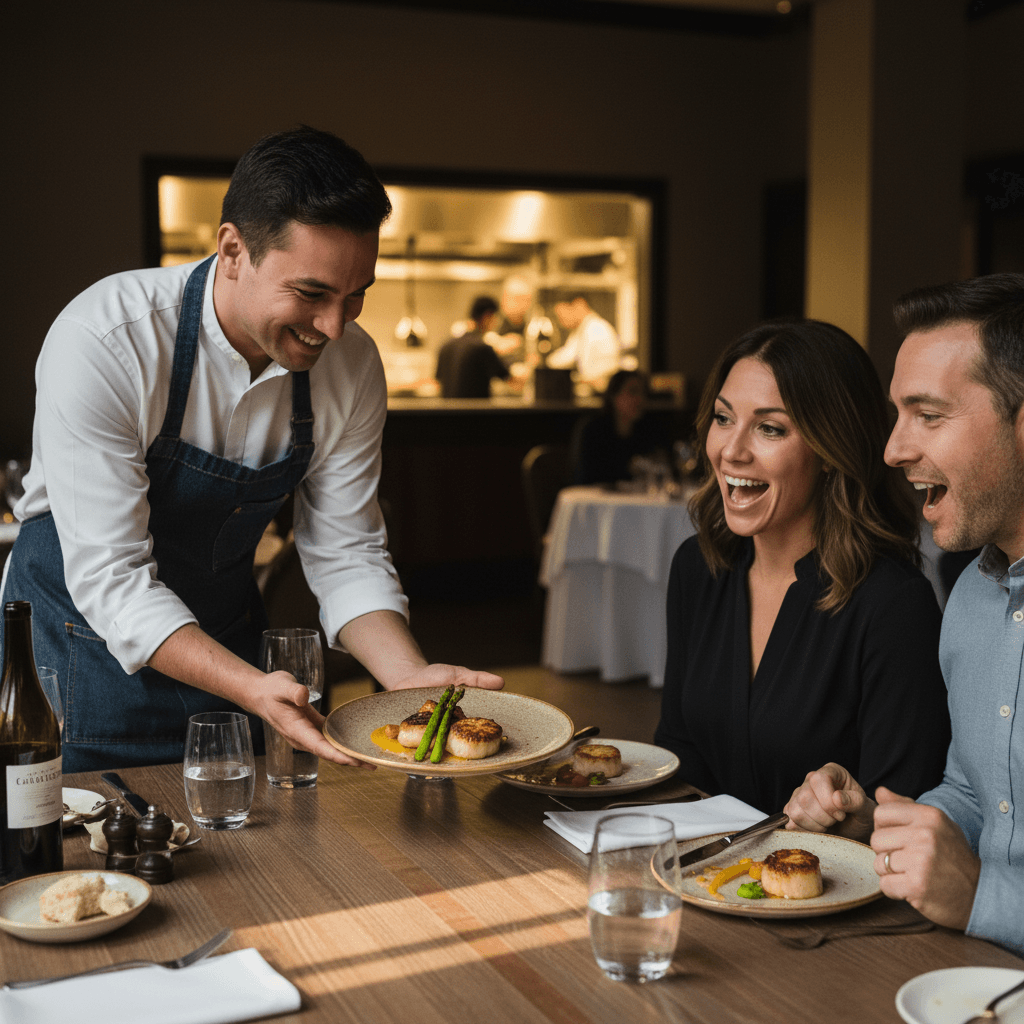
First shift: The presentation pause. Train your servers to hold the dish at eye level for two full seconds before placing it on the table. This isn't hovering. It's a deliberate pause that makes everyone at the table look at the food. It frames the plate as an arrival, not just another delivered item. During Saturday lunch, this two-second hold gives the table time to register the colors and composition before utensils move.
Second shift: The ingredient spotlight. As the server sets the plate down, they name one visual element. "Notice the herb garnish on top," or "See how the sauce pools around the steak." Use simple, descriptive language that points to what's beautiful. This verbal cue directs attention to the details your kitchen worked on. It turns anonymous food into a story.
Third shift: The share prompt. This is the verbal nudge that makes photography feel organic. A server says, "This looks almost too beautiful to eat first," or "The colors on this are incredible." These statements are observations, not commands. They give permission for someone to say, "Wait, let me get a picture of that." The photo becomes part of enjoying the experience, not interrupting it.
When Memory Fails During The Rush
Knowing these shifts is one thing. Executing them during Saturday night chaos is another.
The problem is cognitive overload. At 7:45 PM, the expo is calling three tickets at once. Servers are juggling drink orders for table two, appetizers for table five, and entrees for table seven. In that pressure cooker, trained rituals evaporate. The presentation pause gets skipped because the line cook needs a runner now. The ingredient spotlight is forgotten because four other tasks are screaming for attention.
Beautiful plating gets rushed to tables without its accompanying story. The $28 halibut special arrives silently next to the water glasses. The customer cuts into it without a moment of appreciation. The kitchen's visual work - the crisp skin, the vibrant pea puree, the delicate fry garnish - becomes background noise to conversation. Training fades when tickets back up and muscle memory defaults to speed over experience.
This breakdown isn't about poor staff performance. It's about a system that doesn't support consistency under fire. You can't rely on willpower during peak service. You must build cues into the environment itself.
Making Photo Moments Your Restaurant's Rhythm
The goal is to make these shifts automatic, not extra tasks.
Build them into your pre-shift briefing as muscle memory drills, not theoretical discussions. Role-play the presentation pause with empty plates during lineup. Practice saying one ingredient spotlight phrase out loud until it sounds natural, not scripted. This rehearsal turns theory into habit before the first guest arrives.
Create simple visual cues in your kitchen flow. Place a small piece of colored tape on your expo station where servers pick up plates. That tape is a physical reminder: "Pause here." It triggers the two-second hold without requiring conscious thought during rush hour. For the line cooks, standardize one visually striking element on every dish - a bright herb, a colorful dusting of spice, an edible flower - that servers can consistently name during their spotlight.
Track what actually works in real service. Which servers get tagged in customer photos most often? Don't just notice it - investigate it in your next team meeting. Ask them specifically what they said or did at that moment. "Sarah, you were tagged three times last weekend on the burger shot. What did you do when you set it down?" Share those exact phrases and actions with the whole team as concrete examples of success.
The objective isn't staged photography with perfect lighting and props. It's creating natural moments worth remembering and sharing because they felt like part of a great meal, not an advertisement.
Manual systems work when discipline is high and volume is manageable.
But consistency across every shift requires support tools that embed these rituals into your operational workflow without constant manager oversight.
Taking the Next Step
Shifting from silent tables to shared moments is practical work with clear logic behind it.
You start with one ritual - likely the presentation pause - and drill it until it becomes as automatic as clearing empty glasses.
If building this consistent rhythm across every server and every shift feels like a manual challenge you're ready to systematize, explore how modern restaurant platforms can help codify these service standards into your daily flow.
View our pricing for details or start a free trial to see how digital tools can turn these photo moments from occasional wins into your restaurant's reliable signature