When Your Signature Dish Becomes Two Different Meals
Recipe cards work for one kitchen. They fail when you add a second location. Here's how to fix plating consistency before customers notice.
The Night Two Regulars Ordered Different Meals
When Your Signature Dish Becomes Two Different Meals, you lose more than a sale. You lose trust. It was a Tuesday night at the downtown location. Two regulars, Mark and Sarah, sat at their usual corner booth. They ordered the same thing they always do: the braised short rib with parsnip puree. They eat it every other week at our northside spot. The plates came out. Mark took one bite and looked at Sarah. "This isn't right," he said, not to the server, but to his wife. The puree was thinner. The sauce was sweeter. The meat didn't have the same crust. They didn't send it back. They just ate quietly and paid the check. That silence costs more than any bad review.
A bad review is public. You can respond to it. This is private disappointment that spreads through whispers between friends who trust each other's taste. They won't tell you it's wrong. They'll just stop coming to the location that got it wrong, or worse, stop coming altogether because they can't trust what they'll get. This is the exact operational breakdown we address in When Your Second Location Breaks Your First, which maps out how to scale your systems without losing control of the experience.
The problem starts in your recipe binder. Your head chef at the flagship knows the dish by heart. Their "pinch of salt" is consistent because it's their hand, their muscle memory. But when that chef trains a new sous at the second location, that "pinch" becomes a variable. The new cook is nervous during a Friday rush. The expo is calling three tickets at once. That's when the pinch becomes a grab, and the grab changes the dish.
Stop Writing Recipes Like Cookbooks
The fix begins by throwing out your written recipes during service hours. Words fail under pressure. Instead, build visual recipe guides that work during the rush.
Take your signature salad. The written card says: "3 oz mixed greens, 2 oz cherry tomatoes, 1.5 oz crumbled goat cheese, 4 slices of cucumber, 2 tbsp vinaigrette." Now picture a new hire on their third shift, tickets piling up on the rail. They're not weighing 3 oz of greens. They're grabbing a handful and hoping it's close.
Build portioning tools instead of writing descriptions. For the salad: Get a specific-sized bowl for the greens line cooks use for that salad only. Fill it once - that's your 3 oz portion. For the tomatoes, use a 4-ounce deli container. Fill it to the top - that's your 2 oz portion. For the vinaigrette, use a pump bottle that dispenses exactly 2 tablespoons per press.
The Rule: If a measurement can be turned into a physical container or tool, it must be. Your best cook's intuition is not a system you can scale. A 4-ounce deli container is.
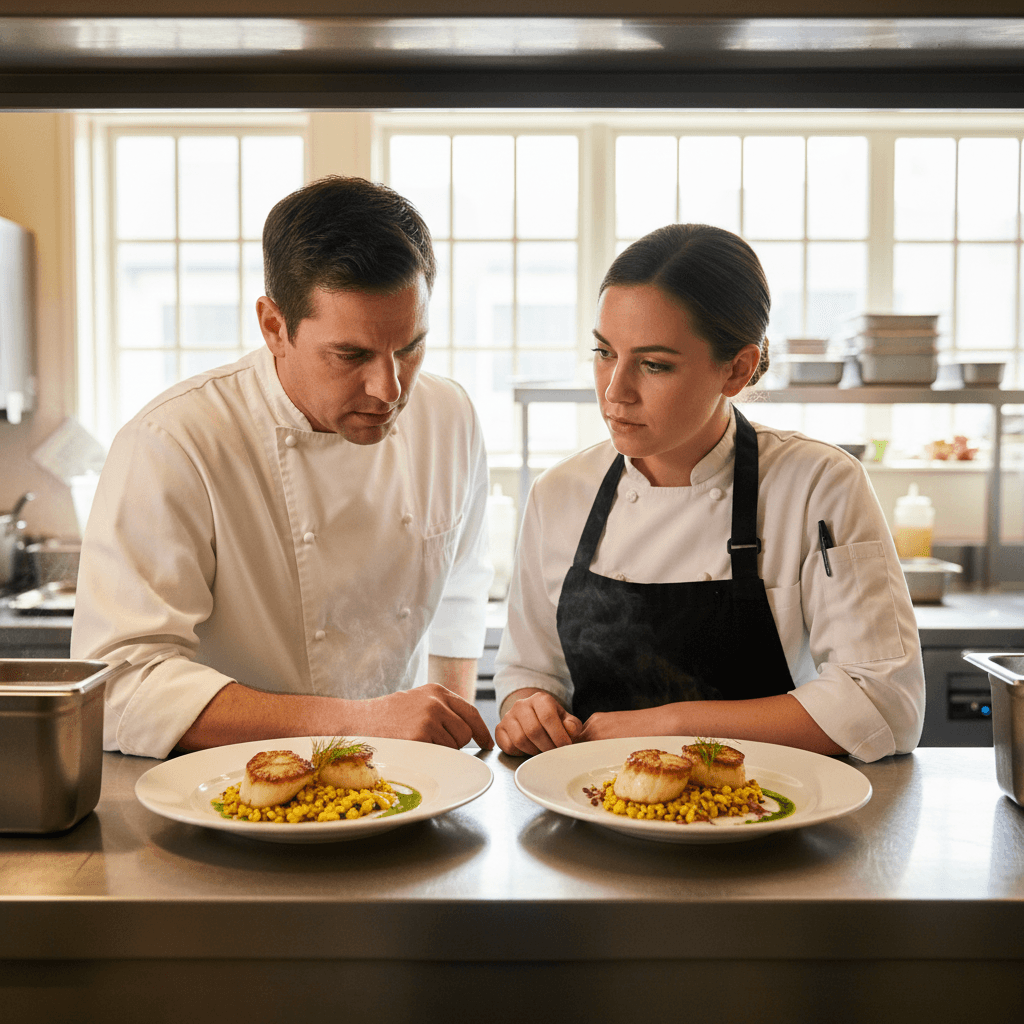
This applies to cooked items too. Your pan-seared scallops should have a visual guide taped to the pass: a photo of three perfect scallops on the plate with correct sear and placement. Next to it, keep a metal ring cutter used only for plating the accompanying risotto cake. One scoop into the ring, leveled off, equals the exact portion every time.
Training becomes demonstration, not explanation. You show the new cook: "Greens in this bowl. Tomatoes in this cup. Press the pump once." You're not teaching them to cook; you're teaching them to assemble using foolproof tools. This cuts plating time during a rush because there's no thinking, just doing.
When Your Recipe Binder Becomes a Paperweight
Visual tools solve today's problem, but they create tomorrow's bottleneck: maintenance. Your beautiful binder of photos and portion guides works until you have staff turnover, menu changes, or seasonal ingredients.
The three-ring binder lives in the manager's office. A new cook starts on a busy Saturday. The binder isn't on the line where decisions are made in seconds. They ask a busy line cook how to plate the special. That cook gives them the 30-second version, not the standardized version. Consistency slips away in real time.
Seasonal changes break manual systems. Your summer salad uses heirloom tomatoes cut into wedges. Your visual guide shows wedges. Fall comes, and you switch to roasted squash cubes. Someone needs to retake the photo, print it, laminate it, and replace the old guide on the line. In the week between deciding on the change and updating the guide, two different cooks are plating it two different ways based on verbal instructions.
Staff turnover erodes standards. Your veteran sous who helped create the guides leaves for another job. They took all the unwritten rules in their head about when to adjust seasoning for humidity or how to judge doneness on that tricky fish special. The new hire has the laminated card but not the context.
Paper systems are static; restaurants are dynamic. A supplier runs out of your specific brand of crumbled feta mid-service on Friday night. The expediter shouts "Use the block feta in the walk-in and crumble it!" How much of the block equals your usual 1.5-ounce portion? No one knows quickly enough, so they eyeball it. The dish goes out different.
Building a Kitchen That Teaches Itself
The goal is to build a kitchen where systems train new staff automatically. The layout itself should enforce consistency before anyone reads a manual or receives verbal instruction.
Start with standardized plating stations. Every station that plates your signature dishes should be set up identically across locations. The mise en place for the short rib dish should be in the same order on every pass: puree container, hot holding tray for meat, garnish container, sauce bottle. A new cook transferred from northside to downtown should be able to step onto the line and know exactly where everything is without asking.
Label everything with weight or count. Don't just write "parsnip puree" on a container. Write "Parsnip Puree - 2 oz Scoop" right on the side. The scoop should be physically attached to the container with a piece of kitchen twine. For proteins, use portioned bags labeled with weight and count: "6 oz Scallops - 3 per order." The label does the teaching.
Create visual guides that live at point-of-use. Laminate your plating photo and tape it directly onto the sneeze guard above where that dish is assembled. Include critical cues: "Sear marks facing up," "Sauce dot here," "Garnish last." When tickets print for that item, cooks look up and see exactly what they need to build.
This reduces training time by 70%. Instead of two weeks of shadowing and memorization, a new hire gets one shift of following visual guides with tools designed to prevent error. They become productive faster because you've removed variables and decisions from their workflow.
Audit your current recipes this week. Pull your top three selling dishes from last month's sales report. For each one, walk through plating it during a slow period and ask these questions: 1) Where do we measure? Replace every measurement with a physical container or tool. 2) Where do we decide? Remove decision points (like "season to taste") with fixed amounts (like "two cranks of pepper mill"). 3) Where do we look? Move instructions from binders to where hands are working - tape them to coolers, rails, and plate racks.
Taking the Next Step
Recipe standardization isn't about creativity; it's about delivering what you promised on every plate across every shift and location. The logic is simple: consistent tools create consistent portions which create consistent dishes which build customer trust.
Manual systems built with visual guides and portioning tools form an essential foundation. They address most of your immediate consistency problems directly from your kitchen inventory without complex technology. But maintaining those paper-based systems across multiple locations requires constant discipline and manual updates every time you change an ingredient or a procedure.
Modern kitchen display systems can automate this workflow by putting digital recipe guides directly on screen at each station during service. Digital inventory tools can track ingredient changes across suppliers and automatically flag when portion sizes need adjusting for substitutions.
If inconsistent plating is costing you regulars like Mark and Sarah, view our pricing for solutions designed specifically for multi-location kitchens, or start a free trial to see how digital standardization works during your next dinner service