Stop Wasting Food During Prep
Broken prep systems don't just waste food - they slow your entire kitchen. Fix the habits that cost you time and money before service even starts.
The Hidden Cost of Every Wasted Onion
Stop Wasting Food During Prep. It's 4:45 PM on a Friday. The first dinner tickets are hitting the rail, and your lead line cook is searching for the julienned peppers. He opens three identical cambros before finding the right one. The other two containers - one from yesterday, one from this morning - get pushed to the back of the lowboy. They'll be thrown out tomorrow. That's not just a few dollars in spoiled vegetables. It's thirty seconds of a cook's time during your busiest rush, multiplied across every ingredient that isn't where it should be. The real cost is measured in lost speed and added stress, not just your food cost percentage.
This waste starts hours before service, when prep systems break down. A cook spends ten minutes peeling onions that end up in the trash because no one labeled the container. Another portioned twice the needed chicken because the prep list was unclear. These small failures compound into a slow, chaotic kitchen when you can least afford it. For a complete breakdown of how broken systems create bottlenecks during service, see our guide on Kitchen Speed: When Your Line Cooks Are Waiting.
Think about your last inventory count. You see the dollar amount of wasted food. But you don't see the forty-five minutes of prep labor that went into peeling, chopping, and portioning that food before it spoiled. You don't see the two minutes your sauté cook wasted during Saturday night dinner searching for that mislabeled sauce. The financial loss is visible on your P&L. The operational cost - the lost time and added friction during service - is invisible but far more damaging to your customer experience and staff morale.
Label Everything Twice - The Contrarian Rule
Most kitchen managers teach a simple rule: label everything once when you prep it. Date it, initial it, move on. This works in theory. In practice, during a busy service, it fails completely. A line cook grabbing unlabeled or poorly labeled containers during the rush will waste more time questioning what's inside than taking two seconds to mark it properly when it reaches the line.
The Rule: Label when you prep, then label again when you move to the line.
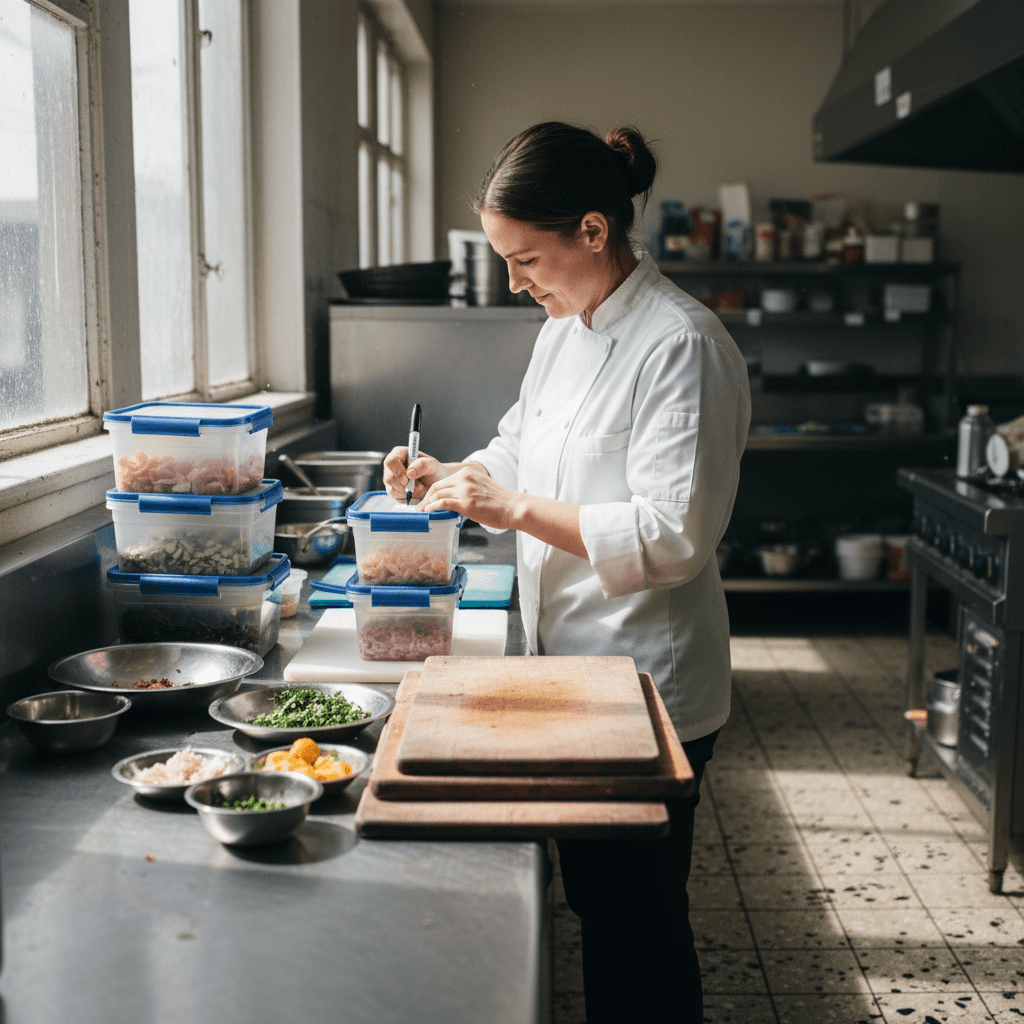
Here is how this works on your floor. Your morning prep cook portions chicken into four hotel pans for the sauté station. He labels each one clearly with contents, date, and his initials. At 3 PM, your line cook sets up his station. He takes two of those pans to his lowboy. This is the critical moment. He must take a Sharpie and write "CHIX SAUT" directly on the plastic wrap covering the pan before he puts it away. Not on a piece of tape that can fall off. Directly on the wrap.
Why twice? Because during service, your cook is reacting to tickets, not reading fine print. He needs to identify ingredients at a glance, from three feet away, with sweat in his eyes and the expo calling two more orders. A clear, bold label on the container he actually grabs saves three seconds of hesitation. Multiply that by twenty ingredient grabs during a rush, and you've just bought back a full minute of productive cook time.
This manual fix saves both food and time. It prevents the "mystery container" syndrome - that half pan of something pushed to the back of the cooler because no one is sure if it's today's batch or needs to be tossed. It eliminates the quiet question between cooks: "Is this the new aioli?" That question kills momentum. Proper labeling answers it before it's asked.
When Your Memory Becomes the Bottleneck
Your labeling system works perfectly on a slow Monday with one prep cook. It works until Tuesday lunch when three cooks are prepping simultaneously for a catering order and regular service. Now you're relying on human memory instead of reliable systems. The expo calls for more julienned peppers for the fajita station. Your pantry cook checks the lowboy. He sees two containers of peppers.
One is from today. One is from yesterday afternoon. Which is which? The tape label on one is smudged from condensation. The other has no date, just "PEPPERS J" in faded ink. He has to open both, smell them, maybe taste them to be sure. This takes ninety seconds during lunch rush. He picks one, and the other gets forgotten in the back again, destined for the trash tomorrow.
Manual tracking collapses under volume and pressure. You cannot rely on staff to remember what they prepped three hours ago when tickets are flying and everyone is in motion. The system must work independently of memory.
The solution is visual management at the point of use. Color coded tape works for some kitchens - green for today, yellow for yesterday, red for toss. For others, it's as simple as a dedicated shelf or rack labeled "TODAY'S PREP" right at the line cook's station setup area. Anything that moves from walk-in to line must pass through this checkpoint and get its final service label.
This isn't about bureaucracy. It's about removing decision fatigue during crunch time. Every second a cook spends figuring out what something is or if it's still good is a second they're not cooking food for a waiting guest.
From Wasteful Prep to Faster Service
The connection between organized prep and kitchen speed is direct and mechanical. Every minute saved in proper labeling and portioning becomes an extra minute available during your busiest shifts.
Think about your dish pit as an example of this flow. Dirty plates come back, get scraped and racked, go through the machine, come out clean, get stacked neatly for servers to grab. If plates are stacked wet or put away in the wrong place, servers waste time searching during service, slowing down table turns.
Your food prep line works exactly the same way.
Prepped ingredients are your clean plates. They need to be stored correctly so cooks can grab them without thinking. Start tomorrow's prep with this mindset: dated containers are non negotiable. A sharpie on a string at every station is mandatory equipment. Watch how much faster your line moves when everyone knows exactly what they're grabbing without a second thought.
Portion control is part of this same system. If you prep too much of an item that won't sell, it spoils. If you prep too little, you have to stop service to make more - what kitchens call "86ing" an item. Both scenarios waste time and money. The fix is tracking what you actually sell. Not guessing. Not using last week's numbers. Look at yesterday's sales mix. Prep based on those real numbers plus a small safety buffer for today's forecast.
This daily adjustment cuts waste dramatically. If you sold fifteen salmon portions last Friday but only ten this Friday because it rained, prepping twenty "just in case" means five go in the trash. Prepping twelve saves food cost and fridge space. That saved fridge space means cooks find things faster. It all connects.
Taking the Next Step
Stop Wasting Food During Prep by fixing your labeling habits first. The logic is clear: organized ingredients lead to faster cooks and less spoilage. This shift requires no new technology - just discipline with a Sharpie and a commitment to visual organization at every station.
Manual systems work but require constant reinforcement. Modern digital inventory tools can automate date tracking and portion alerts, turning daily guesswork into simple checklist tasks for your team. If consistent tracking has been your challenge, view our pricing for systems that scale with your operation, or start a free trial to see how automated prep lists can streamline your morning routine before your next busy weekend