How to Increase Average Spend Per Head
Stop guessing what customers spend. Learn practical ways to track and increase average spend per head without annoying your guests.
When Guests Leave Money on the Table
How to Increase Average Spend Per Head starts with a Tuesday night table. Your server just dropped the check. Two guests, two entrees, two waters. No appetizer. No dessert. No wine or cocktails. They were friendly, they enjoyed their meal, and they left a decent tip. But they also left $30 to $40 on the table. That's the silent leak.
This isn't just a math problem. It's a series of missed connection moments. The server was busy, the kitchen was in the weeds with a large party order, and the suggestion for a starter never happened. The opportunity for a glass of wine that would have complemented the salmon perfectly passed by unnoticed.
The real cost is cumulative. Let's do the simple math. If your average spend per head is $32 and it could be $40, that's an $8 gap. In a 50-seat restaurant turning tables twice a night, that's 100 covers. That's $800 left on the floor every single night. Over a month, that's $4,000. That's a new piece of equipment, an extra staff member for peak hours, or pure profit. This is why tracking this number matters, and it's one piece of the system explained in Restaurant Reports That Actually Work, which shows you how to move from guesswork to clear decisions.
The Server's Secret Weapon
The fix begins with your staff, but not with aggressive upselling. The Rule: Don't upsell - suggest.
Upselling feels transactional. It puts pressure on the guest and the server. Suggesting is collaborative. It positions the server as a guide helping the guest have the best possible experience. This shift in mindset changes everything.
Train this in 15 minutes at your next pre-shift meeting. Use the three-part suggestion formula that works during a rush: 'Many guests enjoy...' + 'It pairs well with...' + 'Shall I add one?'.
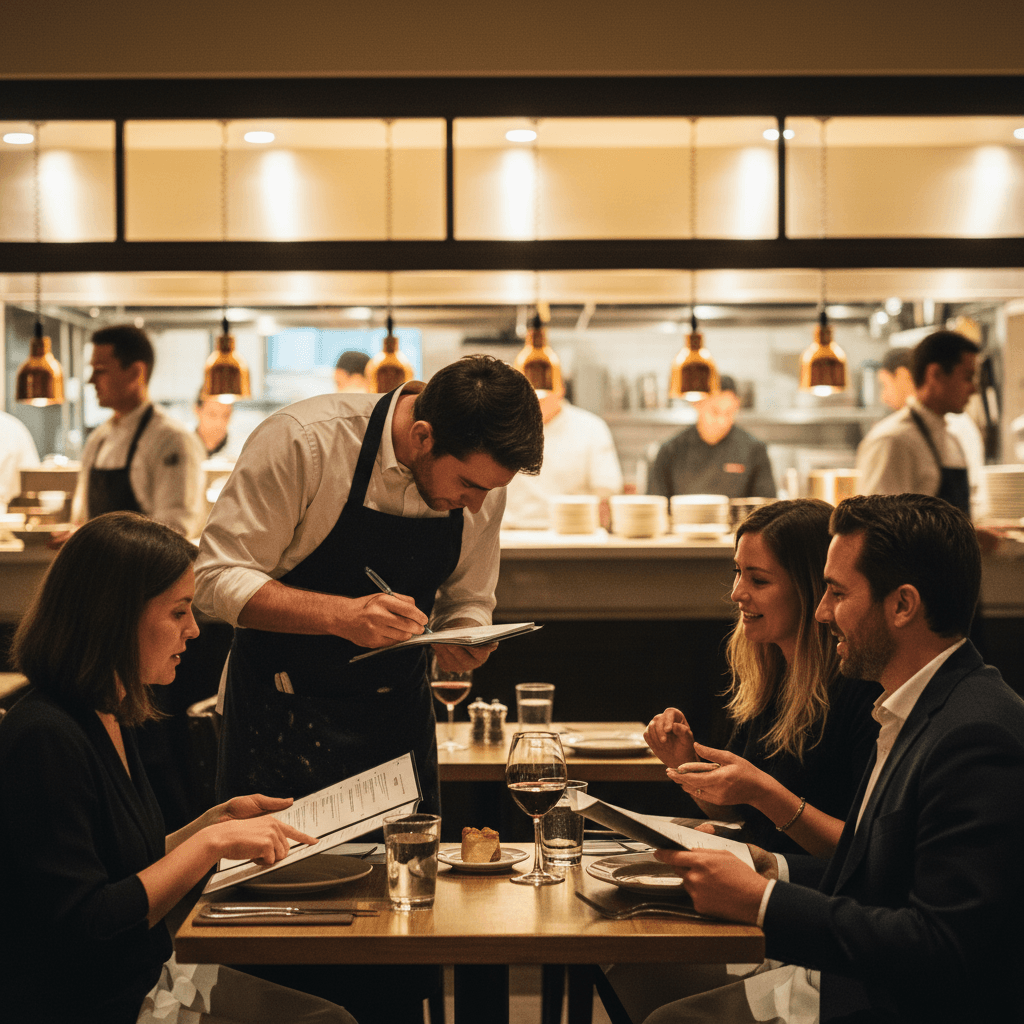
Role-play with real menu items. "Many guests enjoy starting with the burrata plate while they look over the menu." That's social proof, not pressure. "It pairs really well with a glass of our Sauvignon Blanc." That's expertise and creates a complete experience. "Shall I add one for you to start?" That's a simple, closed-ended question that makes saying 'yes' easy.
The dessert trick adds $6 without feeling pushy. When clearing the main plates, don't ask "Would you like to see the dessert menu?". Instead, make a specific, positive observation. "The kitchen just pulled a fresh batch of our chocolate torte - it's still warm." Then pause. If they show interest, follow with the three-part formula: "Many guests share it with two spoons... it goes perfectly with a decaf coffee... shall I bring one out?"
Why Memory Fails During Friday Rush
Your servers now know what to suggest. But during Friday night service, memory becomes the bottleneck.
A server takes an order for table 12: two steaks, no appetizers, two sodas. They meant to suggest the wedge salad and a red wine by-the-glass. The expo calls three orders at once, a drink ticket gets misplaced, and the intention is forgotten. Two hours later, when that table gets their check, you've lost that potential $25 addition.
Manual tracking creates guesswork instead of data. If you ask your team on Saturday how their suggestions went, you'll get vague answers. "Pretty good." "I think I sold a few desserts." This isn't useful feedback. You can't coach what you can't measure.
The chaos of the expo station kills good intentions. When tickets are piling up and the printer is running non-stop, the focus narrows to survival: get food out correctly and drinks refilled. Strategic suggestion becomes a luxury of slower nights.
When spreadsheets become yesterday's news before they're even finished, you know the system is broken. Asking a manager to manually log every suggested add-on in real-time is impossible. By the time you compile last week's data, you're already into next week's service with no actionable insight.
From Tracking to Training
The goal isn't just to track numbers - it's to turn those numbers into actionable staff feedback that changes behavior.
Start with a weekly 10-minute review session. Before Sunday brunch service, gather your servers. Don't use vague percentages from a point-of-sale report. Use specific examples from their shifts. "Sarah, on Friday you had a four-top that ordered the scallops. What did you suggest with it?" The conversation becomes real and immediate.
Celebrate small wins to reinforce good behavior without punishing misses. "John, I noticed you suggested the artisan cheese board to three different tables last night and two said yes. That added $45 to your sales effortlessly. Great job." This positive reinforcement is more powerful than criticizing missed opportunities.
Focus your training where your data tells you to look next. If your beverage sales are low but dessert sales are strong, don't waste time on dessert training drills. Run a 5-minute session on wine pairings for your top three entrees instead.
Use contribution margin - what's left after food cost - to prioritize suggestions. A $16 steak that costs $5 to plate has an $11 contribution margin. A $9 glass of wine that costs $2 has a $7 contribution margin. A $8 dessert that costs $2 has a $6 contribution margin. Guide your team toward suggesting higher-margin items first during busy periods where time is limited.
Taking the Next Step
Increasing average spend per head is about building better habits into your service rhythm. It turns missed opportunities into consistent revenue without making guests feel pressured. The logic is clear and the execution happens one table at a time.
The manual process works but requires constant discipline and observation. Modern restaurant technology can automate the tracking piece, freeing you and your managers to focus on coaching instead of data entry. Digital tools can provide real-time prompts to servers and instantly show what suggestions are working.
If you're ready to move from guessing to knowing what drives your profitability, you can view our pricing for solutions designed for busy operations or start a free trial to see how automated tracking changes your next service shift