Why Seasonal Coffee Drinks Lose Money
Your pumpkin spice latte is costing you more than you think. Learn the real math behind seasonal drinks and how to make them profitable.
The Seasonal Drink Trap: When Pumpkin Spice Costs More Than Coffee
Your seasonal specials are bleeding cash. That pumpkin spice latte you sold for $6? The syrup costs $0.75 per pump, the whipped cream adds $0.40, and the special cup sleeve is another $0.25. You're left with $3.60 before labor and rent. Most coffee shops lose money on their most popular seasonal items because they don't track ingredient costs in real time.
Why seasonal coffee drinks lose money is a math problem disguised as a marketing success. You see the line out the door for your peppermint mocha in December and think you're winning. The real story is in the waste bin at closing - half-used bottles of specialty syrup, expired garnishes, and whipped cream cans with one serving left that get tossed. This connects directly to the daily profit systems we break down in The Coffee Shop That Actually Makes Money, which moves beyond busyness to actual bank deposits.
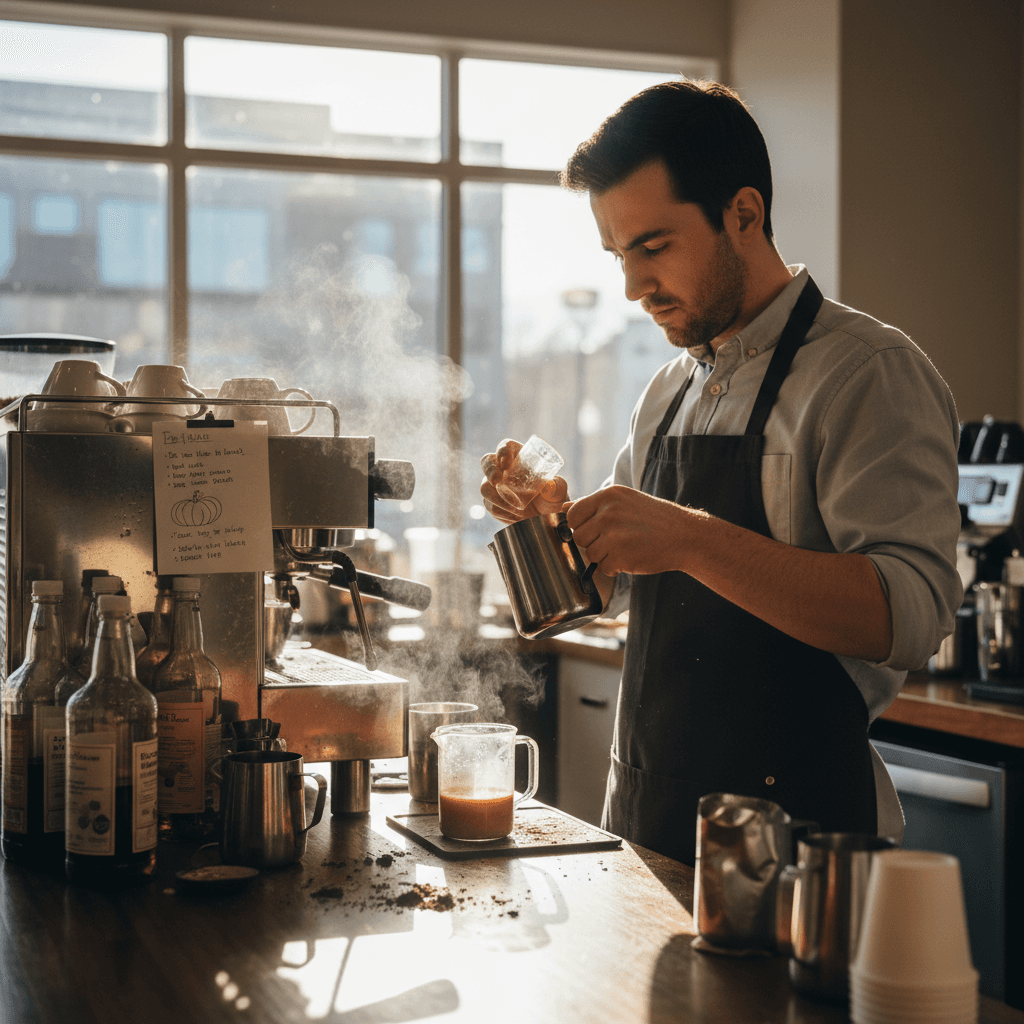
Picture your Friday morning rush. The barista is three drinks deep on a caramel apple cider order. The recipe card says two pumps of caramel. She gives it three because the first pump seemed light. That extra pump costs you $0.35. She doesn't know that because no one told her. You won't know until the end of the month when food costs are 5% over budget. By then you've sold 300 of them.
Count Everything That Touches The Cup
Here's the hard truth: if you're not weighing your syrups and measuring your garnishes, you're guessing your costs. Every pump of caramel sauce matters. Every sprinkle of cinnamon counts. Take 15 minutes before your next shift to weigh exactly how much whipped cream goes on each drink. Measure how many pumps of syrup your staff actually uses versus what the recipe card says. You'll find discrepancies that cost you hundreds each week.
The Rule: Anything that goes in or on the cup gets measured once a week during a slow period. Tuesday at 2 PM is perfect.
Grab your kitchen scale and a shot glass. Pump your vanilla syrup ten times into the glass. Weigh it. Divide by ten. Now you know what one pump actually weighs in grams, not "about a tablespoon." Do this for every seasonal syrup and sauce. Your chocolate sauce might be thicker this year from a new supplier - meaning each pump has more product and higher cost.
Now watch your barista make three of your seasonal specials during a moderate rush. Time them. Do they use the measured shot glass for syrup? Or do they free-pump directly into the cup? Free-pumping is faster but inconsistent. That inconsistency is pure profit leaking onto the counter.
The Recipe Card Lie
Your printed recipe cards become suggestions during a rush. Baristas eyeball measurements when the line is six deep. That extra pump of vanilla syrup adds $0.35 to your cost but doesn't change what you charge customers. The problem isn't your staff - it's that you can't update pricing fast enough when ingredient costs change mid-season.
Seasonal ingredients have volatile pricing. Your pumpkin puree supplier might have a bad crop year. The price jumps 20% in November, right when you're selling the most pumpkin lattes. Your menu board still shows $5.75 because changing printed menus takes two weeks and costs $300.
Your staff follows old recipes with new, more expensive ingredients. They don't know the cost changed because no system tells them in real time. So they keep making drinks that now cost you $4.10 to produce instead of $3.80. You're losing $0.30 on every sale during your busiest season.
The solution lives in your pre-shift meeting next Thursday.
Gather your team before opening. Show them the actual bottles, cans, and bags that make your seasonal drinks. Put price tags on them with the cost per serving written in large marker.
"This bottle of gingerbread syrup costs us $18 wholesale," you say, holding it up. "It contains roughly 60 pumps." "Each pump costs us $0.30." "Our holiday latte uses two pumps - that's $0.60 just in syrup before milk, cup, or labor."
Suddenly it's not just "gingerbread syrup." It's 60 cents of cost they control with their thumb.
When Seasonal Becomes Permanent
The real bottleneck happens when a seasonal drink sells so well you want to keep it year-round. Now you're stuck with specialty ingredients that cost three times more than your regular supplies because you're buying smaller quantities.
Your inventory system wasn't built for this hybrid model, so you end up with expired pumpkin puree in July.
You created a summer blackberry cold brew that crushed sales in August. Customers keep asking for it in October. You decide to make it permanent. Now you need blackberry syrup year-round, but your distributor only carries it seasonally in large batches. You find a specialty supplier who sells small quantities at a 40% markup. Your food cost on that drink just jumped from 28% to 35%, but you haven't adjusted the menu price because "it's our signature drink."
Worse - you forget to adjust your par levels. You keep ordering blackberry syrup like it's August, but sales drop by half in November. Now you have three bottles expiring in January that you paid premium prices for. That's $54 worth of syrup in the trash because your system still thinks every season is peak season for every item.
The Rule: Any seasonal item that stays on the menu for more than four months gets recosted as a permanent item with year-round supplier contracts.
This means sitting down with your supplier and saying "I need this blackberry syrup every month at a consistent price." You'll get better rates for committed volume. You'll also need to adjust your inventory counts to reflect slower off-season sales. Four bottles in summer becomes two bottles in winter. Simple math prevents expensive waste.
From Seasonal Chaos to Year-Round Profit
Stop treating seasonal drinks as temporary experiments. Build them into your permanent cost structure with clear margins from day one.
Calculate the true cost before you ever steam the first milk - not after you've sold 200 drinks at a loss. Start with your target food cost percentage. Let's say you want all drinks at 25% food cost or lower. If your pumpkin spice latte sells for $6, its total ingredient cost cannot exceed $1.50. Now work backward from that number.
Milk: $0.45 Espresso: $0.40 Cup and lid: $0.15 That leaves $0.50 for pumpkin syrup, whipped cream, cinnamon sprinkle, and special sleeve. Weigh each component until you hit that number. Maybe you use one pump of syrup instead of two. Maybe you skip the whipped cream unless requested (and charge extra). Maybe you use a standard sleeve instead of custom printed ones.
This discipline forces creativity within financial boundaries. You might discover that serving the drink hot instead of iced saves $0.20 on ice volume (yes, ice has cost). Or that making your own spice blend is cheaper than pre-mixed syrups.
The manual work here is weekly measurement and team communication. Every Tuesday, measure something new - how many chocolate shavings come from one block, how many servings are in a can of whipped cream. Tell your team the numbers at Wednesday's pre-shift. "Team, our peppermint sprinkles cost $0.05 per drink. Please use the measuring spoon - not a pinch." They'll understand because they see the direct connection between their motion and your margin.
Modern digital tools can automate this tracking once your manual process is solid. Inventory software can alert you when seasonal ingredient usage spikes beyond recipe standards. Digital menu boards let you adjust prices instantly when supplier costs change mid-season without reprinting anything. These tools handle the repetitive counting so you can focus on training and quality control.
Taking the Next Step
Seasonal drinks should build profit, not erode it. The math is straightforward once you measure what actually happens during service instead of what's written on paper. Consistent costing turns holiday specials from financial risks into reliable revenue streams.
Start with one drink this week - weigh every component and calculate its true cost against what you charge. Then view our pricing to see how digital tools scale this manual discipline across your entire menu year-round. When you're ready to track ingredients as precisely as you track cash, start a free trial and build your first profitable seasonal menu today