Delivery That Actually Makes Money
Stop losing money on delivery orders. Learn the real costs and how to structure your menu for profit.
When Delivery Eats Your Profit
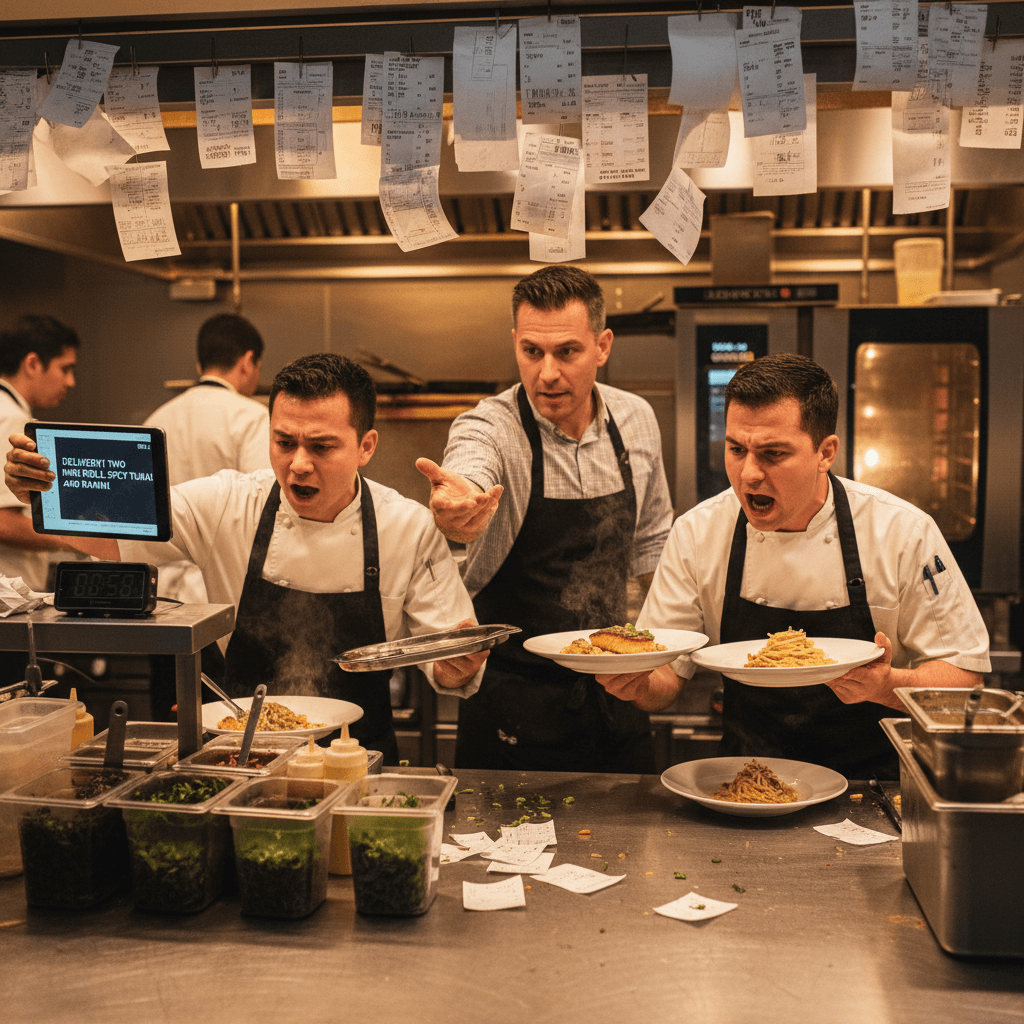
The expo station is calling three orders at once. Two are for dine-in tables that just sat down. The third is a delivery order that needs to be bagged and ready in four minutes. The kitchen printer keeps spitting tickets. A server is waiting for a side of ranch. This is Friday night, and you are losing money on every delivery order you send out the door. Making delivery profitable starts with seeing the real costs that happen during this exact moment.
The hidden costs most restaurants miss are not on your P&L statement. They are in the three minutes your line cook spends assembling a delivery order instead of plating for the dining room. They are in the extra packaging that gets used because the first container leaked during a test run. They are in the phone call from an angry customer whose fries arrived cold, which ties up your host for ten minutes during peak hour. These costs are silent. They do not show up as line items. They show up as longer ticket times for your paying dine-in guests.
Real numbers from Friday night rush tell the true story. Your kitchen can handle 40 covers per hour during dinner service. Add ten delivery orders, and that capacity drops to 32 covers. You just lost eight paying customers because your line was interrupted. Each of those lost tables represents an average check of $75. That is $600 in lost revenue, plus the actual loss on the ten delivery orders you sold at a slim margin after commissions and packaging. The math is brutal and immediate.
How delivery changes your kitchen flow is physical. Dine-in tickets move in a rhythm: appetizers, entrees, desserts. Delivery tickets are a chaotic blast of entrees and sides that all need to be fired at once and packaged perfectly. It breaks your kitchen's natural pacing. The sauté cook has to stop saucing plates to bag up four burgers. The fry station operator is now also a quality control inspector, checking that lids are sealed. This disruption has a direct cost measured in seconds per ticket, which compounds into thousands of dollars per month.
Why Your Current System Is Bleeding Money
You know the problem: delivery feels like a necessary evil. Here's why your current fix fails.
The commission myth says third-party fees are just part one. A 30% commission on a $20 order takes $6. You think you have $14 left. You are wrong. That $14 must now cover the food cost, the packaging, the labor to assemble it, the credit card processing fee on the total sale, and the operational drag on your kitchen. What looks like $14 is often $7 or $8 of actual contribution before fixed costs. You are working for the platform, not for your restaurant.
Hard truth: Your own menu pricing is likely wrong for delivery. You priced your chicken sandwich for dine-in service. It accounts for the ambiance, the service, the refillable drink. None of those value factors exist in delivery. The customer receives a box. Yet you charge the same price and give away 30% of it. This is backwards math. Your dine-in price is built for one cost structure. Delivery requires its own.
Why free delivery destroys margins is simple arithmetic. Offering "free delivery" means you absorb that cost. If it costs you $4 in platform fees and driver pay to get the food across town, that $4 comes directly from your already-shrunken profit on that order. You are paying to give your product away. This is not marketing; it is subsidizing a customer's convenience with your rent money.
The packaging problem nobody talks about is waste and inefficiency. The cheap clamshell that steams the fries soggy costs you a refund. The plastic sauce cup that leaks all over the bag costs you a negative review and a remade order. The time spent hunting for the right size bag during rush hour costs you two minutes of expo time. Every packaging failure is a double loss: the cost of the item and the cost of the operational error it creates.
Building a Menu That Delivers Profit
That's the trap of using your full menu for delivery services. This is how you escape it.
The delivery-only section strategy is non-negotiable. Create a separate menu section within your delivery platform profiles called "Travels Well" or "Kitchen Favorites." This section contains 8-12 items maximum. These items are chosen for durability, consistent quality after 20 minutes in a bag, and higher contribution margin after all costs.
How to price for real costs means building from the bottom up. Start with food cost. Add packaging cost (use real numbers from your supplier). Add commission fee. Add a labor allocation for assembly (2-3 minutes at your kitchen's wage rate). Add credit card processing on the total. Now add your target profit. The number you get is your delivery price. It will be higher than your dine-in price for the same item. This is correct.
Which items travel well and which don't is a matter of physics. Fried items get soggy. Salads wilt. Anything with a crispy component fails. Steamed buns get dense. The winners: braised meats, stews, grain bowls with sturdy vegetables, pressed sandwiches, anything in a sauce that benefits from mingling. Test every item by cooking it, packing it, driving it around the block for 15 minutes, and then eating it. If it is not excellent, it does not go on the delivery menu.
The upsell that actually works on apps is not "add a drink." Drinks are heavy and have low margin after packaging. The effective upsell is "make it a meal." For a $16 sandwich, offer "The Works" for $22. This includes the sandwich, seasoned fries (which travel better than regular fries), two signature sauces, and a cookie. You added $6 of perceived value with about $1.20 in additional food cost. The customer feels they got a deal. You just increased your profit on the order by nearly $5.
The Friday Night Delivery Drill
You have a profitable menu built for travel. Now you need an operational plan that works when both dining rooms are full.
Pre-shift setup for mixed service means designating physical space. Set up a dedicated delivery packing station away from the main expo line. Stock it with all packaging, bags, napkins, utensils, and stickers during slow hours before dinner. Print out route maps for your drivers if you use your own. This station should be ready to function without anyone searching for supplies. The Rule: If someone has to leave the station to find something during rush, your system has failed.
Who handles tickets when expo is overwhelmed must be decided before service starts. The best answer is one dedicated person - not your expo cook. This could be a manager or a designated back-server. Their only job from 6 PM to 9 PM is to monitor the delivery tablets/printers, call tickets to the appropriate line station, and pack finished orders at the dedicated station. This keeps the main expo focused on the dining room tickets, which have higher margins and tip out servers.
Timing adjustments for different platforms are critical. Platform A might promise 15-minute pickup times while Platform B allows 25 minutes. You must know these windows and fire tickets accordingly. Fire all items for Platform A orders together as soon as you get them. For Platform B, you can sometimes hold appetizers or time things closer to driver arrival. Mixing these up means cold food or drivers waiting in your lobby - both cost you money.
Quality control when you can't see the customer happens at the packing station. The packer is your last line of defense. They must check every item: lids sealed, sauces included, napkins packed, order ticket attached correctly. They should have a heating lamp if possible to hold hot items for two minutes while finishing assembly without losing temperature. This two-minute investment prevents a 30-minute problem later when an angry customer calls.
From Cost Center to Profit Center
A smooth operation turns delivery from a headache into just another revenue stream with its own rules.
Tracking what actually matters means looking beyond total sales volume. Track contribution margin per delivery order (sales minus food cost minus packaging minus commission). Track average ticket time impact: how many minutes were added to dine-in tickets because of delivery interference? Track refunds and remakes by item to identify which dishes truly do not travel well. This data tells you what to keep, what to fix, and what to cut.
When to say no to certain orders is a powerful lever. If you use multiple platforms, turn off all but one when you hit 80% dining room capacity. Say no to orders from outside your reliable delivery zone - cold food guarantees a loss. Pause ordering entirely during your absolute peak 90 minutes if your kitchen cannot handle mixed service yet. Protecting your core dine-in business is more important than fulfilling every delivery request.
The one change that makes biggest difference is psychological: stop treating delivery as supplemental income. Treat it as its own business unit with its own menu, pricing, cost structure, and operational standards. When you manage it with this focus, you stop making compromises that drain profit from your main restaurant. You start making clear decisions based on what makes this specific channel successful.
Taking the Next Step
Delivery will either drain your resources or contribute to them - there is no middle ground once volume arrives.
The operational shift from chaos to control happens one deliberate step at a time: building the right menu first, then creating physical systems, then training staff on timing, and finally learning when to pause incoming orders to protect quality across all channels.
Stop losing money on orders you cannot see leave your kitchen - view our pricing tailored specifically for managing multi-platform delivery operations, and start a free trial this week to test these systems during next Friday's dinner rush without financial risk